Saturday, February 1, 2014

Did I Mention It Also Travels in Time?: Hampton Court Palace

Harris asked me if I'd ever been in the maze at Hampton Court. He said 
he went in once to show somebody else the way. He had studied it up in a 
map, and it was so simple that it seemed foolish - hardly worth the 
twopence charged for admission. Harris said he thought that map must 
have been got up as a practical joke, because it wasn't a bit like the 
real thing, and only misleading. It was a country cousin that Harris 
took in. He said:

"We'll just go in here, so that you can say you've been, but it's very 
simple. It's absurd to call it a maze. You keep on taking the first 
turning to the right. We'll just walk round for ten minutes, and then go 
and get some lunch."

They met some people soon after they had got inside, who said they had 
been there for three-quarters of an hour, and had had about enough of it. 
Harris told them they could follow him, if they liked; he was just going 
in, and then should turn round and come out again. They said it was very 
kind of him, and fell behind, and followed.

They picked up various other people who wanted to get it over, as they 
went along, until they had absorbed all the persons in the maze. People 
who had given up all hopes of ever getting either in or out, or of ever 
seeing their home and friends again, plucked up courage at the sight of 
Harris and his party, and joined the procession, blessing him. Harris 
said he should judge there must have been twenty people, following him, 
in all; and one woman with a baby, who had been there all the morning, 
insisted on taking his arm, for fear of losing him.

Harris kept on turning to the right, but it seemed a long way, and his 
cousin said he supposed it was a very big maze.

"Oh, one of the largest in Europe," said Harris.

"Yes, it must be," replied the cousin, "because we've walked a good two 
miles already."

Harris began to think it rather strange himself, but he held on until, at 
last, they passed the half of a penny bun on the ground that Harris's 
cousin swore he had noticed there seven minutes ago. Harris said: "Oh, 
impossible!" but the woman with the baby said, "Not at all," as she 
herself had taken it from the child, and thrown it down there, just 
before she met Harris. She also added that she wished she never had met 
Harris, and expressed an opinion that he was an impostor. That made 
Harris mad, and he produced his map, and explained his theory.

"The map may be all right enough," said one of the party, "if you know 
whereabouts in it we are now."

Harris didn't know, and suggested that the best thing to do would be to 
go back to the entrance, and begin again. For the beginning again part 
of it there was not much enthusiasm; but with regard to the advisability 
of going back to the entrance there was complete unanimity, and so they 
turned, and trailed after Harris again, in the opposite direction. About 
ten minutes more passed, and then they found themselves in the centre.

Harris thought at first of pretending that that was what he had been 
aiming at; but the crowd looked dangerous, and he decided to treat it as 
an accident.

Anyhow, they had got something to start from then. They did know where 
they were, and the map was once more consulted, and the thing seemed 
simpler than ever, and off they started for the third time.

And three minutes later they were back in the centre again.

After that, they simply couldn't get anywhere else. Whatever way they 
turned brought them back to the middle. It became so regular at length, 
that some of the people stopped there, and waited for the others to take 
a walk round, and come back to them. Harris drew out his map again, 
after a while, but the sight of it only infuriated the mob, and they told 
him to go and curl his hair with it. Harris said that he couldn't help 
feeling that, to a certain extent, he had become unpopular.

They all got crazy at last, and sang out for the keeper, and the man came 
and climbed up the ladder outside, and shouted out directions to them. 
But all their heads were, by this time, in such a confused whirl that 
they were incapable of grasping anything, and so the man told them to 
stop where they were, and he would come to them. They huddled together, 
and waited; and he climbed down, and came in.

He was a young keeper, as luck would have it, and new to the business; 
and when he got in, he couldn't find them, and he wandered about, trying 
to get to them, and then HE got lost. They caught sight of him, every 
now and then, rushing about the other side of the hedge, and he would see 
them, and rush to get to them, and they would wait there for about five 
minutes, and then he would reappear again in exactly the same spot, and 
ask them where they had been.

They had to wait till one of the old keepers came back from his dinner 
before they got out.

Harris said he thought it was a very fine maze, so far as he was a judge; 
and we agreed that we would try to get George to go into it, on our way 
back.

Three Men in a Boat, Jerome K. Jerome


Hampton Court gets its own post because it honestly kept me entertained all day.

This time I just cut to the chase and started by myself. A few members of our party didn't show up, and I volunteered to wait at the entrance for a while to see if they would. They didn't. So I gave the entrance stickers back to the ticket office and went exploring.

Hampton Court is a palace outside of London that used to belong to Cardinal Wolsey. He gave it to Henry VIII when it looked like Henry was thinking about executing him. Henry took the palace and executed him anyway. in the classic Tudor style.

William III (of William and Mary) added on a bunch of extensions in the Georgian white-pillar sweeping-staircase lots-of-air-and-light style, in neat contrast to the Tudor 'we have to put in windows so we don't run into things, but don't expect us to be happy about it' look. William had intended to pull down and rebuild the whole thing, but ran out of both money and interest when Mary (of William and Mary) passed away. So it's half Tudor, half Georgian, all history.

When you pick up your audio guide, you can also get a nice velvet surcoat, so you feel all medieval and swishy. I got a red one. The extra layer was no bad thing, because the day went from cool and humid to cold and raining, and neither the Tudors nor the late Stuarts were particularly stellar about heating. I decided to do the palace in chronological order, so I started with the exhibit on young Henry VIII and worked my way forward to the death of William, listening to the whole dang audio guide because I like stories and I had all day and there was no one around to tell me to hurry up because they wanted to go to McDonald's.

I ended up spending a lot of time in front of the very big fire in the kitchens, chatting with the fire-keeper and listening to him expound on the restoration work that needs to be done on the chimney and the cultural motivations for 1960s psychedelic music and King Henry's health problems and the fun the food historians have when they get the run of the kitchens on the first weekend of every month. (Must come back to see that, in honor of cooking guild.)


When I'd given the kitchens a thorough exploration, I headed up to the state rooms upstairs, where I got a little turned around, chronologically, and my BYU education held me in good stead.

I was just exploring this lovely gallery, where according to record Katherine Howard ran to try to meet the king and beg for her life, only to be grabbed by her guards and dragged away screaming, when who should wander by but Anne Boleyn, with a waiting woman in tow. (I knew it was she because of the round hood and the B pendant with the three pearls. Kinda hard to miss that one.)

Fortunately, years of practice in the Medieval Club has taught me the proper etiquette and skill for just this situation. I dropped into a courtesy (and did it gracefully and steadily, with no wobbling, and without stepping on my skirt [if I'd been wearing one]) and stayed down with my eyes on the floor until invited to rise.

I assumed she was the queen. She was strutting around like she owned the place, and had a waiting woman trailing after her, instead of being herself a waiting woman trailing after Katherine of Aragon. Maybe the waiting woman was Jane Seymour? I didn't ask. Kind of an awkward question anyway.

But, just to throw off my chronological bearings, about an hour later I ran into Thomas Cromwell, who escorted me and a few other tourists to the presence of the king (after giving everyone a quick lesson in the courtsey-and-stay-there rule, of which, as I have earlier demonstrated, I am already master). And Henry was in the midst of debating the scriptural authority of the pope. So he seemed to think he was married to Katherine. So I had no idea where I was.


When am I? What year is it? And who's the bally queen?
I really wanted to jump into the debate on papal authority, but decided instead to mind my manners and listen quietly until the king dismissed us. When he did, I was the only member of our group who knew the 'don't turn your back on the monarch until you're out of the room' rule. And I didn't even trip on anybody. HA! I win Tudor court etiquette.

Thank goodness I was backing into this enormous dining hall, and not out of it.
Since I'd comported myself so well in Tudor times, I decided to fast forward a couple hundred and try my luck with William and Mary.

They weren't in, but their various audience chambers were super pretty. Here's the guard room.


On the one hand, it's very cool to have all these decorations made of guns, and in theory it's handy to have them in the guard room where they might be needed, but . . . how exactly does one get up there to get them down? I have this mental image of soldiers trying to boost one another up to grab the low-hanging rifles.

Mirrors seemed to have become a thing by this point, so here's a selfie in the withdrawing room. 

And here's a portrait of Charles I, which is a little creepy for an English monarch to be hanging on the wall. But take note of the carvings around the frame. All life-size 3-D woodwork. It was just psychotically pretty. 

William also laid claim to the most comfortable-looking historical toilet I'd yet encountered. I kind of like how, if the lid were closed, it would just be disguised as a box, sitting in this tiny room for no particular reason. 

Royal velvet stealth toilet. 
Out the windows, I got tantalizing views of the grounds, looking utterly gorgeous, but by this time it was well into the afternoon and raining pretty hard. 


So I unfortunately had to give the grounds a miss, saving for another day the legendary Hampton Court Maze of Jerome K. Jerome satirical fame. Instead, I found the palace cafĂ© and had just about the nicest bowl of parsnip soup and cup of tea it has ever been my pleasure to enjoy. 

Curry and coconut milk, the waiter informed me. So yummy. 
As I finished my soup, the palace was really honestly closing for the day, so the staff cheerfully kicked me out and I cheerfully went, after surrendering my audio guide and surcoat. Only to discover that the trains were a mess all over the southeast due to a death on the tracks somewhere, so there would be no service to the Hampton Court station for the foreseeable future. Instead, I got loaded onto a bus and taken to a different station, where I was able to catch an express to Waterloo and wend my way home from there.

And now I shall get myself out of bed, this Saturday morning, and go find some more trouble into which to get myself.

Friday, January 31, 2014

Stonehenge and Bath; or, RoseE Gets Lost in Museums

Understand this: me getting lost in museums is not a new thing. It's been regular practice since I was about three. Quite simply, museums are more interesting than watching the people I'm supposed to be following. So I'll wander off, either unknowingly or with the assurance that I'll find them later because finding them right now would mean I'd have to stop looking at the museum.

So we got to Stonehenge. We were supposed to be split into two groups: one to see the museum first, and one to take the little shuttle-thing out to the site itself. I was in the museum-first group. Awesome! thought I. So I headed into the museum.

About ten minutes in, I noticed that I didn't know any of the people around me. Did my people all go to the restroom or the gift shop? Probably. They're silly like that. I went back to reading about cremation burials.

Then I ran into Jarom. "Hey, do you know where anybody else is?"

"I think they went out to the place," said Jarom.

As Jarom is, at least in my company, as taciturn as a really, really good lawyer, I was actually impressed I'd gotten that much vocalization out of him. Already gone out? We weren't supposed to switch for another fifteen minutes. And I wanted to read about the modern druidic sun ceremonies.

I read about them really fast, as a kind of compromise, and then went in search of anyone that I knew besides Jarom. The visitors' center was deserted.

So I hopped on a shuttle and went to Stonehenge, making Jarom come with me.


Gray skies are very fitting for seeing Stonehenge. It's . . . epic. It's solid, and permanent-looking, and epic in a "I'm going to be here when your children's children's children's birth certificates have crumbled to dust" kind of way. I didn't get to ponder the experience very much, because who do I meet on the way up but EVERYBODY on the way down. Of course.

I was kind of shocked how close the path came to the site itself. I thought it'd be one of those pay-a-quarter-into-the-giant-binoculars-and-be-grateful kind of spectacles, like many national parks I've visited. You can't walk up into the site, of course, but you get plenty close enough to be very impressed.

I was mildly annoyed that I didn't find a Pandorica, though. Or a centurion. Well, there's still the London Eye that needs to be checked under.

Anyway, I did a whirlwind tour of Stonehenge and hustled back down the hill to make it to the bus in the traditional nick of time. That's okay, though. Like Mount Rushmore, Stonehenge is cool to see, but truth be told it doesn't actually do much. So you can see it and be impressed and then be done.

Anyway, on to Bath!

In Bath we actually did manage to pull off the two-groups thing, one starting in the Jane Austen center and one in the Roman baths. I started with Austen. On the walk there, through the very cute, very Georgian streets of the town, I entertained myself and bored others with my jabbering about how Austen was a better novelist than anybody before the proper literary genre of novels was even a thing. Or, to put it another way: she mastered the form before the form had even been formed.

The Austen center was a little museum, so it was physically very difficult for me to be separated from my very large party. And despite my mild annoyance that Austen had to be commemorated in a town in which she hated living, I was impressed by the interactive nature of the exhibits. There were cookies to sample and clothes to dress up in and pens and ink to play with and books to read. The museum focused very specifically on Austen's experiences in Bath and her novels that are set there, which I appreciated.
Penmanship practice.
They also had a very cute collection of film-adaptation memorabilia, the cutest of which were donated by Emma Thompson.

Emma Thompson is pretty good at drawing elephants. 
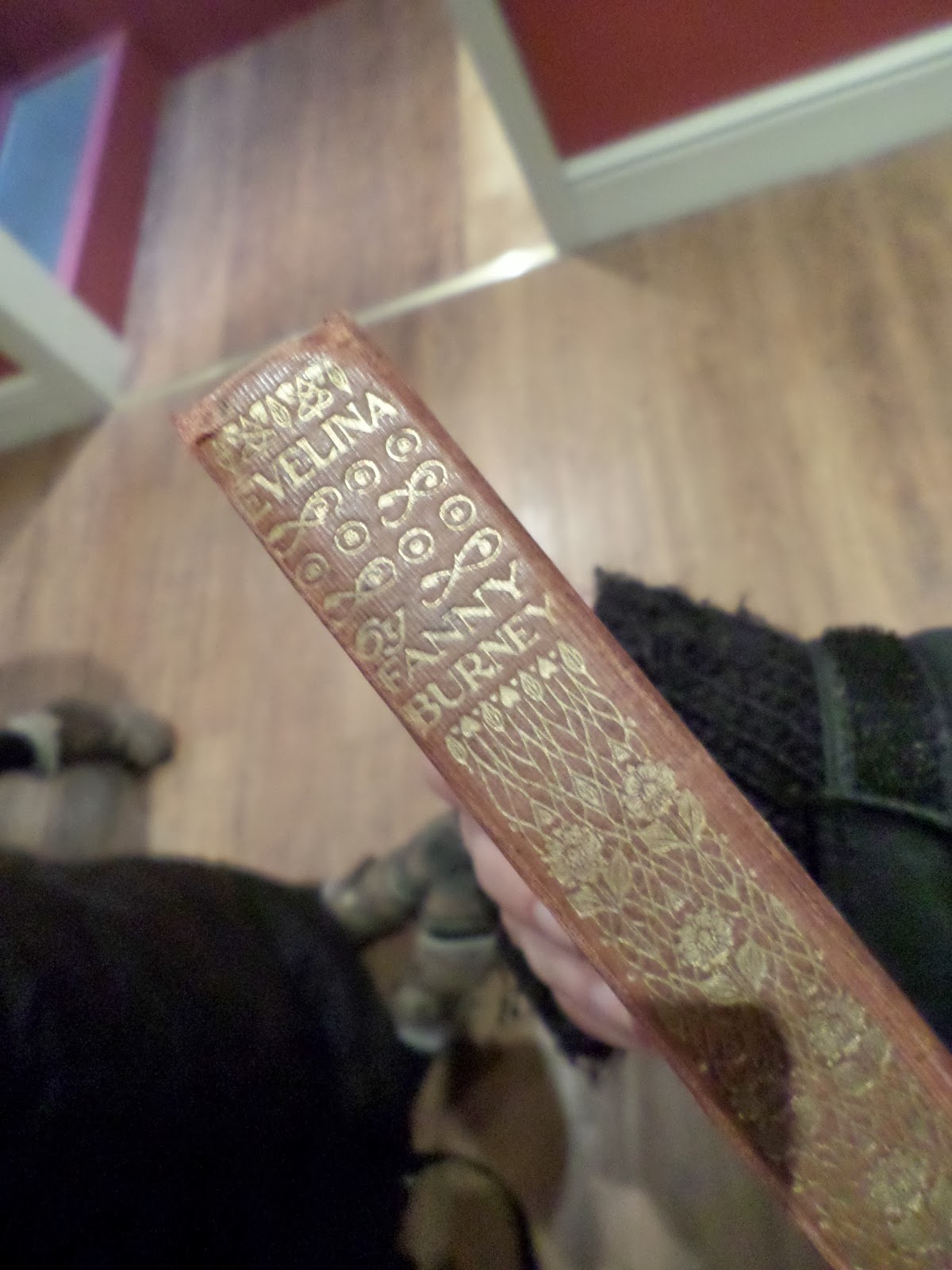
I also rejoiced to stumble across this lovely old 1920s edition of a book Austen would have had on her own shelf, and which has become firmly ensconced as one of my favorites. It's a good thing this wasn't for sale, or I might not have been eating for the next month.


I was sorely tempted to just sit down on the floor and read the thing (and you know I'd have done it, if I thought I could get away with it), but Dr. C. required my company for City-of-Bath explorations.

The most profitable of these turned out to be a woolen shop, where I ransacked the 'As-Is' rack and came away with a lambswool sweater for five pounds. It was discounted because it has a hole in it.

The words going through your head right now are "What hole? Where?" That is what I said. It took me five minutes to find the hole. I will sew up the hole when I finish this blog post. This task will also take me five minutes. And then you will NEVER find the hole.

So, between the sweater and a pretty pair of earrings that were also five pounds because one of the backs was missing (apparently an earring back fetches roughly nine pounds around here), I made out like a bandit at the woolens store in Bath.

Then I went to see the actual Baths, the this-is-why-it's-called-Bath baths. Here they are.


This is a freaking fantastic museum. Fan-dang-tastic. Great collection from the excavations here, awesome interpretive stuff, and . . . the bath! It's still going! Not to bathe in, as we have out-Romaned the Romans in developing health and safety regulations. But the pool here is still filling with water out of the excavated channel, and is draining out of the excavated drain. It is still warm and toasty water. They're using it to heat the museum. 
Water comes in here. It is not this orange; the flash was weird.

Beyond this pool were the excavated (but not reconstructed) sauna rooms and plunge pools and exercise pools and changing rooms. At various points around the complex, projectors showed Roman people wandering around. Inasmuch as this is a bath house, these wanderers often sported naked butts, some of which were attractive enough to be worth the price of admission on their own merits.

In the midst of my delighted wandering through the bath house, temple, and museum (and stalking a bunch of Korean tourists, because it was delightful to hear this described as a Roman mokyeoktang), I looked around myself and discovered . . . well, wouldn't you know it. Alone again.

Meh.

So I had to take a selfie of me taking the waters.


The waters are not very delicious. But I haven't gotten sick since drinking them, so who knows? Perhaps Sulis Minerva, or Jane Austen, or both, have blessed me.

Two more footnotes before I leave this post and go fix that sweater.

To bide my lonely time until the bus came back, I wandered into Bath Abbey, as is my wont, and had a nice time exploring it. People keep telling me that Britain is now a very secular, non-religious country, but I keep running into lots and lots of religious people. But I keep running into them when I'm ducking into churches to go exploring, so there may be a sampling bias there.

Truth, be told, the churches are all kind of starting to blur together. But here's a bit that stood out in this particular space:


This is the altar of the Gethsemane chapel. It took me a few minutes before I realized that the pretty silverwork on the altar cloth is not, in fact, pretty silverwork, but barbed wire, which heads up the curtain and also forms the candle stand. The chapel is set apart for prayers for the suffering and injustice of the world. It was humbling and heartbreaking.

And on a less solemn note, the day after this trip was yet another night at the theater, this time Henry V. I made it on time, despite sneaking in ten minutes of bell practice (and in contrast to Tuesday's performance of Othello, which was rendered nigh-unreachable by a traffic accident. We managed to make it in before anything really exciting happened, though, and because it was an edge-of-town community-kind-of theatre, they still let us in, late and wet as we were. I'd been given to understand that the ushers at Henry V would not be so merciful, so by a goodly sprint up the stairs I made it to my seat in the nick of time.

Jude Law was starring, which would be super exciting if I could remember anything else he's been in. I was more engaged in feeling righteously indignant on David Tennant's behalf, particularly when Henry does this whole prayer-justification about how much penance he's done for his father's having usurped King Richard. And there I am at the top of the seating, scowling and going "Yeah, you should be ashamed! Not that he didn't deserve to get usurped, but do you have any idea how sad he was? Sadder than you are right now about how your invasion of France is going badly, Mr. Whiney!"

It was, however, an excellent show. I loved the Chorus, who looked a lot like Mickey Smith, and I even cried a little at the St. Crispin's Day speech.

Program-mate Tyler ended up with a front-row seat (from besieging the box office at an ungodly hour) and was able to exchange pleasantries with another theatre-going Shakespeare fan . . . Kenneth Brannagh. I was actually glad I was up in the balcony, because the only thing I could have thought of to say would have been, "Yes, I'm loving the show. I'm actually liking it much better than your film version. Sorry. It's just . . . this is very much a 'Hey, look! Characters, and emotions, and drama!' kind of show, whereas yours was 'Hey, look! Kenneth Brannagh reciting Shakespeare!' That and the haircut. What a truly goshawful haircut. Who talked you into that? Oh, and when you next speak to Emma Thompson, tell her she's really good at drawing elephants."

However, for those of you who doubt my ability to mind my manners in front of famous or important people, tune in for our next episode in which I mind some elaborate and quite obscure manners in front of Thomas Cromwell, Anne Boleyn, King Henry VIII, and the fellow who tends the cooking fire at Hampton Court.

Wednesday, January 29, 2014

Aaaaahhh falling behind!

So . . . the Wind in the Willows.

'Twas a ballet. 'Twas enchanting. The set was built primarily as an attic full of old stuff . . . wardrobes and benches and chairs and carpets. The dancers made all of these things into rivers and trees and caravans and prisons and the front steps of Toad Hall. It was very much like being six years old again, and being able to see all the pent-up possibility in everything around you. Absolutely lovely. I haven't any pictures, so I keep forgetting to mention it, but it was lovely. Kenneth Graeme was the narrator, and the cast were just . . . splendid. Telling stories with their bodies. Such a fascinating idea. Such a lovely night.

So . . . bells.


Last Thursday was my first ringing lesson, with ever-patient instructor Billy. I got to pull half-strokes; he caught the bell every time I pulled it so I didn't break anything. I managed to make the bell 'stand' once. (For those of you who are not experts like me, this means getting the bell to come to rest pointing almost straight up. Getting a bell to hang out in this position is what lets you change the timing between rings, which is what allows change ringing to work at all. And I did it! Once.)

Here is a bit of change ringing, for those who have not seen it.


The lady on the far right, in a moment when I wasn't filming her, mis-timed the bell a little bit and, I swear to high heaven, got yanked four inches off her box trying to get the huge tenor bell under control. And nobody thought this was a big deal.

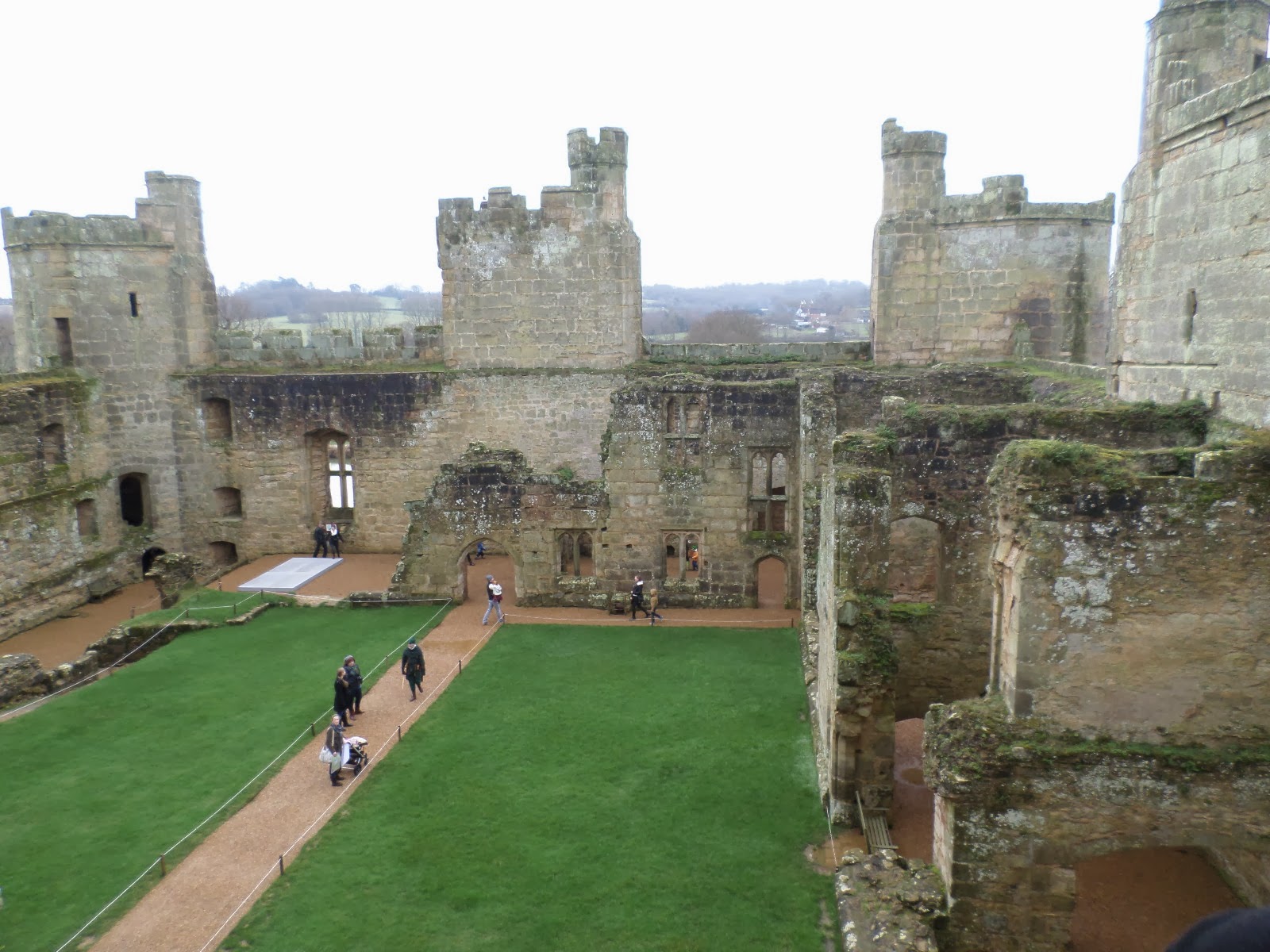
So . . . last Saturday was our run out to Canterbury. On the way, we stopped at this very pretty castle, called Bodiam, which we got to climb around like maniacs. 


Canterbury itself is a lovely little town, though our visit was rather disjointed. We were supposed to see both the cathedral and St. Augustine's abbey. We arrived too late to get to the abbey before our tour at the cathedral. I planned to just go to the abbey afterwards, but then I walked into the cathedral and this was happening: 

Messiah Rehearsal.
I sat and watched until the choir took a break, then actually looked at the actual cathedral like we'd come here to do. So here's the altar where St. Thomas Beckett was killed, by four knights (their four swords are all worked into the cross here: two in metal and two in shadow. I thought that was cool. Also the blending of Thomas's death and Christ's death over an altar where we lay our souls in sacrifice.)


And here's where Beckett's body was entombed until Henry VIII kicked him out and stole his church. Well, Tudors will be Tudors. 


And here's where Edward the Black Prince is entombed! Even Henry wasn't gutsy enough to try to kick out Edward. So there he still is, with replicas of his stuff hanging over him. (The real stuff is in a glass case around the corner. Yep, his shirt survived the Tudors AND the Roundheads AND the Nazis. Told you this guy was a boss.)

Don't Mess With Dead Black Princes.

And just when I was thinking it was time to explore elsewhere, the choir practice started up again.

They'd closed off the nave, in anticipation of closing time for tourists, so I sat on the steps leading up to the quire, behind the risers set up for the choir. (Choir: bunch of people singing. Quire: space specifically designed for the choir to sit in. This choir was too big to fit in the quire, so they were on risers in the nave.) I sat there for the better part of an hour, singing along. I have never heard the Messiah sound quite so magnificent. The basses, like the voice of God; the tenors, like heavenly warrior-angels; the altos like prophetesses; the sopranos as high and clear and bright as the stars. All of their voices were ringing off the stone in every direction. It was amazing. And I sang with them. I sang Handel's Messiah in Canterbury Cathedral. Sure, I snuck into it, but I sang it, aloud, with a full choir, and it sounded awesome.

Guerilla performance. The things I come up with.

I left the cathedral when I was very nicely kicked out, and wandered the dark town by myself for a while. I narrowly avoided being caught in a hailstorm, which was exciting, and had dinner in a little American-style diner while reading The Woman in White, which is also very exciting.

There we go. Updated. Tomorrow, with any luck, I shall tell you all about what happened yesterday (a mad chase to see Othello through some truly tragic traffic), and what happened today (Stonehenge, Bath, Austen, and an Abbey) and what will happen tomorrow (Henry V) and the day after (Hampton Court). It's a pretty exciting week, and it's not nearly done yet. 

Sunday, January 26, 2014

London from Above and Within; or, Last Wednesday at Hyde Park Gate


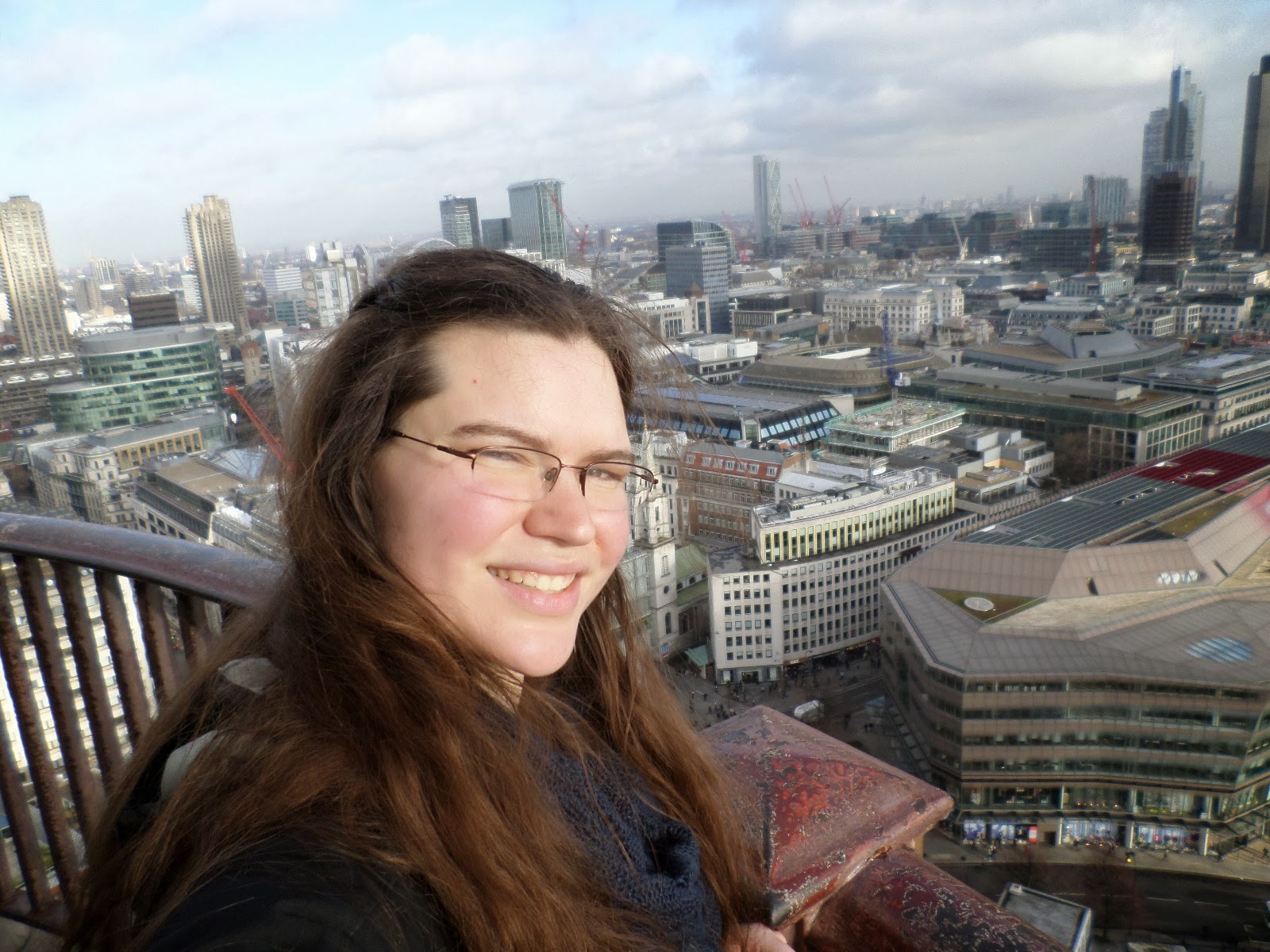
Lady Justice presiding over London.
So, in an effort to catch up before another crazy week starts, let's catch up on what happened in the last one.

For starters, the above photograph was taken from the top of the dome of St. Paul's Cathedral.

It was a long way up.

This is only a little bit of the long way up, and some of the least scary.
Here is a hole in the floor, about a foot square, looking down into the middle of the chapel. And I wasn't even at the top yet.
Being, as you may know, no great fan of heights, I had to make the climb with three points of contact at all times and with my camera's wrist strap buckled into my watch. But I did it. And it was pretty amazing.

St. Paul's really is an astonishingly cool space. It's a beautifully balanced and planned structure, thanks to the genius of Christopher Wren, and it's full of magnificent stuff, but the magnificent stuff got put in after Wren was dead and couldn't protest "Wait! I had it all neatly arranged! It was clean and symbolic and orderly!" Nope, the Victorians just went and plunked the Duke of Wellington in between some columns because there was room for him, and tossed Admiral Nelson down in the crypt next to a handy bust of George Washington round the corner from a medieval Madonna and Child that no one could think what else to do with. And then there's Samuel Johnson's statue in the nave and another Madonna and Child (modern abstract sculpture this time) in the aisle and an enormous pompous grand high altar standing behind the regular, everyday high altar because eh, why not have two? It's part house of worship, part architectural masterpiece, and part National Attic of Stuff.

Included in the category of "stuff": this truly amazing staircase, with each stair supported only by the one below it. 


 So once we came down from the dizzying heights of St. Paul's, we headed off to the Museum of London, which really is an awesome museum. I would have appreciated it a lot more if my legs hadn't felt like tenderized meat by that point. But I managed to catch a nap in a convenient medieval peasant's hovel, so that was all right.

It's not that I couldn't feel my legs, mind you. It's that I WISHED I couldn't feel my legs.
I learned a bit more about Roman Londinium, through a cool exhibit that tied Roman life to modern with such cool things as Harrius Potter et Philosophi Lapis and Winnie Ille Pu, which kind of fill my geek heart with delight.


I also encountered a number of very charming hats. 
I even tried a few. Even if this is the rather demodĂ© Spanish pointed, rather than French round, style. I always did like the pointed a bit better. 
A portion of my time in the museum was devoted to watching Dr. O. try to achieve having all of his children in sight at the same time. This was extremely entertaining. Here, he has corralled one of five and is standing in an extremely cool map of London, coded by socioeconomic status at the turn of the 20th Century.
Many children may have been misplaced, but fortunately I found the Lord Mayor's carriage, complete with six life-sized horses to pull it. The horses are replicas, but the carriage is not; they actually take it out for the Lord Mayor to ride around in. I assume they remove the windows, because if not, heaven only knows how they manage to squeeze that thing out of the building. 

So, RoseE, you ask, are we now caught up on your exciting adventures? Well, no, not actually. Stay tuned for (maybe?) tomorrow's episode, featuring RoseE's first bell-ringing lesson and her debut performance in Canterbury Cathedral, as well as a surprise hailstorm, a traffic jam, a good and proper castle, and a fervent resolution to never again leave the house without a scarf. 

Friday, January 24, 2014

The King and I; or, My Friend Who Tells Me Stories

“Thus play I in one person many people, 
And none contented: sometimes am I king; 
Then treasons make me wish myself a beggar, 
And so I am: then crushing penury 
Persuades me I was better when a king; 
Then am I king'd again: and by and by 
Think that I am unking'd by Bolingbroke, 
And straight am nothing: but whate'er I be, 
Nor I nor any man that but man is 
With nothing shall be pleased, till he be eased 
With being nothing.” 
― William Shakespeare, Richard II


I saw an old friend tonight.

After some little trouble, I obtained a ticket to tonight's performance of Richard II (and, though it cost the earth, I do rejoice that it was quite the best seat in the theater, smack in the middle of the stalls and much more comfortable than standing in the back). After some more little trouble, I returned to the theater in the nick of time . . . thank heaven for Barclay's bicycles, or I'd never have made those last few blocks at anything like the necessary speed.

King Richard was being played by David Tennant. I knew this, of course; it was the main reason I tried for these tickets this morning, rather than Tom Hiddleston's Coriolanus. David Tennant is a Doctor. He is . . . well, famous and all that rot, et cetera, et cetera . . . but when he appeared on stage, I felt as though I'd come to see a show featuring a second cousin or old family friend.

He is an old family friend, you see. He used to come into my parents' living room quite often of a Sunday evening to tell us all stories. In my bewildering, semi-autistic world where names and faces mix together like sequences of random numbers, I know his face, and voice, and name, and step, with a reliable and comforting assurance.

And yet he was also Richard, King of England, so assured of his place in the universe that he never seriously entertained such far-fetched ideas as the rebellion of his nobles. And sometimes in his jumping stride, or some little bit of self-interruption, or in some action meant to wrong-foot and tease everyone around him, he echoed another friend I once had . . . with the same face and much, much shorter hair. (Seriously, that was a magnificent wig. And I only knew it was a wig because I know that he had short hair the last time I saw him, and that human hair doesn't grow that fast.) But this person was different . . . thrown off by the universe, too bewildered to be angry, too observant to be insane, grasping futilely at the empty air where all that love used to be. His death broke my heart. And Henry, now king of England with all the same forms of legitimacy so cherished by his unfortunate predecessor, finishes the play by looking up at his newly-won throne . . . and there stands Richard, barefoot and bareheaded, clad all in loose white, one hand on the arm of the poor rickety chair. This is no ghost of King Hamlet, howling for revenge, nor a forgiving angel. Just Richard, that once was king, solemnly haunting the throne on which Henry must sit for the rest of his days.

And then the lights went down, and came back up, and down the stairs to the floor of the stage sprang my friend David, nightgown billowing around him, smiling the heady smile of one who's just successfully completed three hours of Shakespeare without flubbing a line or stepping on any pieces of broken mirror and is riding that triumphant high even as exhaustion starts to make the edges of his vision go all blurry. I know that feeling, and smile and sympathize as I clap until my palms ache and he and all his teammates make their bows.

There is a crowd at the stage door, waiting with cameras and pens at the ready. I think about joining them, but decide not to. My friend David is probably tired, and wants to go celebrate with the rest of the cast or go home and brush his teeth and go to bed. And anyway, standing in the middle of a mob in the pouring rain is not a good place to catch up with an old friend. So I head for home, confident that when he's rested up from this long and grueling run (only one more day . . . hang in there!), he'll be back in my parents' living room to tell me another story.


Monday, January 20, 2014

What's in a Name? or, That Which We Call a Rose

Moving on to Saturday.

The plan on Saturday was to get a ticket to Richard II. This would have been much easier if I'd actually checked where the theater was before I walked out the door. But I didn't. And it turned out that the theater in question was NOT in the Leicester Square area, whither I wandered for a while, at all. And the tube line that went directly to the theater was down for repairs. So I did not see Richard II.

So I thought to myself, I'll go see the National Gallery. Been meaning to do that. I hopped on the tube and headed back down southward, passing some stops now made familiar by Friday's walk. And on the tube, I thought. Yesterday, we'd been introduced to the Sam Wanamaker Playhouse, which is a brand-new theatrical venue built as a kind of sister site to the Globe. It is a Jacobean, rather than Elizabethan, theater, much smaller than the massive Globe. In the interests of historical accuracy, performances there are candlelit. I'd thought on Friday that such a thing would be a thing worth seeing, so instead of going straight to the gallery, I hopped off the train at London Bridge and retraced my steps back to the theatre.

On the way, I found one of the things we'd been looking for: the Borough Market. I bookmarked it for future reference.

I also found a little sign pointing me to the Rose Theatre. I bookmarked that, too.

I got to the box office and enquired if there were a ticket lying round anywhere for an upcoming show. To my surprise, there was one for the matinee in three hours. Because it was a behind-a-pillar seat, it hadn't sold. I took it, stuffed the ticket in my wallet, and retraced my steps back towards the market to get some lunch.

On the way, I found that sign for the Rose again. What the heck? thought I, detouring thither.

The Rose is currently a tiny little space tucked under an office tower: part archeological site in stasis, part visitor's center, part hipster art venue. It seems they unearthed the site when the land was renovated, and the size and quality of the find took everyone by surprise. But there was neither the time nor the money for a complete excavation, and the poor theater's foundations started to deteriorate when they were exposed to the air after four hundred years, so the site was covered up with sand and mud and plastic sheeting, and then just flooded over.

What you see at the Rose now is a wide, cool pit of black water that trembles subtly at your footfalls. It looks a little like the gates of Moria. The walls and stage of the theater are laid out in red lights that gleam in the blackness. While the Globe is a triumphant monument to History Rebuilt, the Rose is a tenacious embodiment of History Defiant, stubbornly refusing to be forgotten.

The plans for the space are really cool. Suzanne, the nice volunteer who gave me the run-down, informed me that if they can raise sufficient money by June, the government will match it and allow them to finish the dig they started. Then the plan is to preserve the site under a glass floor and create a kind of museum about the archeology thereof. Cool enough. But the last stage of idea-making is to re-build part of the upper theater, making a semi-reconstructed theatrical space for the works of Shakespeare and Marlowe, where the actors will play with the ruins of the old theatre visible beneath their feet. Cool, huh?

I had a nice chat with Suzanne, and she gave me her card so I can call her if I bully enough people into coming back to the site and getting a tour.

"Suzanne, right?" said I.

"Right," she affirmed. "And you're . . ."

"Rose," said I, automatically.

She did a double take, then laughed. Rose in the Rose.

After my splendid journey back through time, I continued on my merry way and finally got my teeth into the Borough Market. It was less like an ordinary farmer's market and more like the Minnesota State Fair, compacted and euro-fied. For instance, what's that extremely noticeable and not altogether pleasant smell?

It's fromage a raclette, bubbling away under long cheese-wheel-cross-section-shaped grills, of course.
 And what's that crowd of people jostling one another to get at?

Why, vegetarian pies stuffed with potatoes and cream cheese and smothered in red-wine-and-onion gravy, of course.
And what are the knobbly alien-looking plants tucked in amongst the other vegetables?

Only brussels sprouts in their natural habitat. 
 And . . . wait, you're telling me that hamburgers aren't made out of ham?

Yep. These are made out of springbok, and ostrich, and alligator, and (I kid you not) zebra.
 And why does everything smell deliciously of warm coconut milk and spices?

Well, because you can't simmer three-foot-wide vats of curry in an enclosed space and not make that space currilicious.
And don't even get me started on the cheese samples, the chocolates, the teas, the wines, and the stacks and stacks of crusty loaves of every kind of bread under the sun. Oh, and did I mention the cheese? The noises I made while sampling those cheeses were absolutely not appropriate for a public space.

At length, happily stuffed on pie, apple juice, cheese, and chocolate pastries, I returned to the Sam Wanamaker. I was early, so I hung out in the gift shop and read Romeo and Juliet in manga form.

The Wanamaker is SO COOL. Everything in it is wood . . . not smoothly varnished wood, but new, clean oak, rough to the touch but splinter-free. It's structured like the Globe, two round balconies stacked over a yard, although the yard is much smaller and fitted with benches like everywhere else. In deference to modernity, there are plain cushions on the benches and safety lights at everyone's feet, as well as windows letting in the fluorescent light from the lobby. But as the show started, the actors lit beeswax candles on the seven big chandeliers that had been lowered to the stage. The footlights went out, and wooden shutters were slid over the windows. (I didn't notice any of this for a while, because a hundred beeswax candles are actually plenty to see by.)

I was, as mentioned, sitting behind a pillar, but it was easy to lean around, or even against, so I was fairly comfy and could see the show just fine. I'd never heard of The Duchess of Malfi, and I just loved it. Great stories are made by great villains, and this show had some of the most fascinating villains I've seen in a very long while. The script was clearly written for just this kind of theater, as one part of it called for complete darkness . . .  something that would have been impossible in the Globe, with its sunlit afternoon performances. The darkness made for a great, and genuinely scary, reveal. A table tried to catch on fire at an early point in the performance, but the lead actress blew it out with a none-of-this-nonsense attitude and went on with her scene.

Great, great show. Great trip back through time. Great experience.

The Wanamaker is still fundraising for their last few hundred thousand, though their first season is already open. There are posters everywhere inviting those wealthier than myself to have their name put on one of the seats for a small 3,000-pound donation. As I did not have 3000 pounds handy, I gave this prospect a miss. But out of curiosity, I did look to see who'd sponsored the seat I'd taken.


Well, how about that.