Wednesday, April 23, 2014

To Resist, or, RoseE in the Sexiest Piece of Clothing of All Time

"Will you come along quietly, or do you intend to resist?"

"Well, don't be stupid! Of course we intend to resist! Just give us a moment, all right?"


Wandered through some novels today.

I started my day feeling very glad I'd decided to do this trip by myself, as it'd be hard to talk someone into coming to see the Musée des Egouts de Paris. Yes, it was smelly. Bring a handkerchief, preferably with a drop or two of perfume in it. Super interesting, though. For instance, do you know that they clean a lot of the larger tunnels by floating a giant wooden ball down them? Like these. See, the ball floats, and since it's blocking most of the tunnel, the water managing to get underneath it is super pressurized from the buildup of water behind it, so it basically hoses the sand and sediment off the bottom of the tunnel.

I feel that this system might bring us some great insight into what was actually going on in that first sequence of Raiders of the Lost Ark.

Look what they found in the sewers:


Swords. Whoops.

Did you know that Victor Hugo was pals with one of the sewer system engineers, and in consequence his portrayal of the network in Les Mis is entirely geographically correct, and Jean even takes the most direct and efficient route from the barricade to Marius's grandfather's house?

So all in all, extremely interesting. Smelly, yes, but educational.

After emerging from the sewer system, I headed up the river a bit to Les Invalides. OH MY GOSH GUESS WHAT IS GOING ON AT LES INVALIDES RIGHT NOW?!?

An exhibit on the Musketeers. Oh, YEAH.

Manuscript copy of T3M on your left there. As in, the handwritten first draft. The real thing.

First edition of first serialized chapter, right here. D'Artagnan riding into town on his horrible decrepit horse right there at the bottom of the third column.


Aside from my slack-jawed fangirling, my higher brain functions managed to note that it was, in fact, an extremely well-researched and -constructed exhibit. It roughly followed the plot of Alexandre Dumas' three Musketeer novels,* using them as a frame in which to contextualize actual historical content. Like who the actual historical musketeers were and what their uniforms looked like and how they were deployed in military contexts and who was in charge of them, and what Queen Anne's diamond studs would have looked like, and who Milady de Winter might be based on. It was really, really cool. And all about masked prisoners and the political careers of Cardinals Richelieu and Mazarin and the construction of the Hotel de Ville . . . and, of course, the long life and distinguished military service of the real Captain d'Artagnan.

So here's a picture of me in the sexiest piece of clothing that has ever been created in all of history or fiction. You can keep your loosened cravats, your wet linen shirts, your swishy capes and long dramatic coats . . . even your stetsons, fedoras, fezes and bow ties. Give me a man in musketeer blue, and I am conquered. And glad to be so.


At length, I went to explore the rest of Les Invalides, including checking to make sure Napoleon was still there. He still was.


I have a vague memory of reading about one of the honored daughters of the Shannon family (possibly Lydia?) causing a scene in this very room because she was convinced the tomb was made of chocolate and was determined to eat it or die trying. Well, the girl's got a case. And once the idea has crossed your mind, you can't un-see it. It's totally chocolate. I mean, actually it's marble, but . . .

And then I went poking around the World Wars, and picked up some cool info about the French Resistance. (Warning: next paragraph is very sad. Skip if necessary, down to the folding motorcycle.)
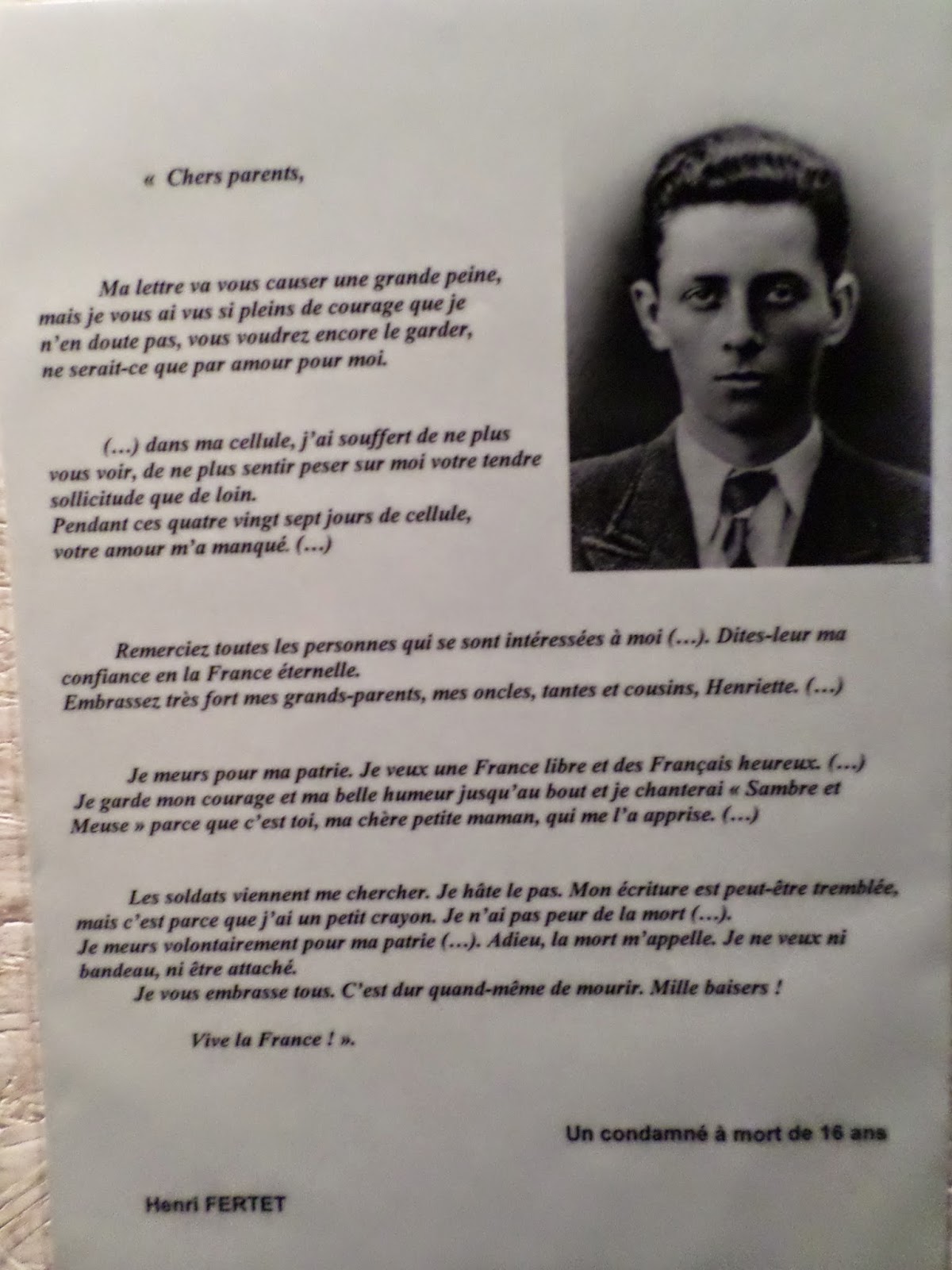

The letter reads:

"Dear parents,

"My letter will cause you great pain, but I have seen you so full of courage that I don't doubt, you will want to keep it, if only for love of me.

"In my cell, I suffered from being unable to see you ever again, to never feel upon me your tender care, except from far away. During these eighty-seven days of confinement, I've missed your love.

"Thank everyone who's been interested in me . . . tell them of my confidence in eternal France. Give big hugs to my grandparents, my uncles, aunts, cousins, Henriette . . .

"I'm dying for my country. I want a free France and happy French. I am keeping my courage and good humor right up until the end, and I'll sing "Sambre et Meuse" because it was you, my dear little mother, who taught it to me.

"The soldiers are coming to fetch me. I await their step anxiously. My writing might look shaky, but that's because I have a short pencil. I'm not afraid of death. I'm dying voluntarily for my country. (...) Goodbye, death is calling me. I won't need to be blindfolded, or tied.

"I love you all. It's hard to die, after all. Thousand kisses!

"Vive la France!"

Henri Fertet. He was imprisoned and executed for his activity with the French Resistance. He was sixteen.

On a much less solemn note, please enjoy this folding motorcycle, dropped in by parachute in a capsule-thing, all ready to go for the invasion. This is the silliest and yet most awesome vehicle ever.


Also, due to weird formatting, you may be seeing a very large picture of two tourists dancing in the rain in the courtyard of Les Invalides. It's a good picture, even if I can't fix its position or size.


*The capitalization here is correct. Dumas wrote three novels about musketeers. One of them was called The Three Musketeers, which makes that sentence a little difficult, but there are in fact two sequels, Ten Years After (which I have not read) and The Man in the Iron Mask (which I have).

Strangers in a Far-Off Land

"Well, wasn't it Shakespeare who said that when strangers meet in a far-off land, they should ere long see each other again?"

"Shakespeare never said that."

"How do you know?"

"It's terrible. You just made it up."

Charade


I had some surprising encounters on my first fully conscious day in Paris.

First, I found myself aux Champs-Elysées.

It was sous la pluie, at about twenty minutes to midi. I'm counting it. And there was tous que . . . well . . . tous que j'ai voulu, I guess, because at the end of them was the Orangerie, which is where dead impressionists live. The big attention-grabber is two astonishingly beautiful Monet panoramas, which are like stepping into a fairy kingdom. Sadly, no pictures allowed.

I did get a picture of this, though: 


I've never been that enamored of Cezanne. Monet was my Impressionist of choice, mostly because my dad showed me one of his Japanese bridges at the Art Institute in Minneapolis when I was little, and I can still remember the magical instant when my dad, after backing me away from the canvas, asked, "Can you see the bridge?" and then suddenly I could. But this Cezanne really grabbed me. He has something Monet doesn't. He can paint summertime. Not just the colors and textures, but the sound and the smell of it. Looking at this painting felt like those precious moments at camp, when it is perfectly comfortable to be outside (rare moments--outside is generally uncomfortable in some way; that's why we invented inside) and there is no pressing task and you know for certain that you will be young forever and ever.

 Here's a pretty picture of a room full of pretty pictures. It is a selfie, one of which I'm rather proud. Can you spot me?


Wandering past the Orangerie, I encountered this rather startling sculpture. Those in the know will understand why this resonated with me.


My next unexpected encounter was while having lunch in the garden (a crepe all stuffed with egg and cheese and mushroom . . . yum). My uninvited guest was a house sparrow, just barely seen here perching on the back of the chair opposite. He wanted to share. I was less enthusiastic.


Then I dove into the Louvre, and encountered lots and lots of things. I encountered La Liberté, but she was busy guidant le peuple so we didn't get a chance to chat. 


I also encountered my heretofore-unknown namesake, the Empress Ariane:


And of course I encountered the strange and magnificent pyramid that is the peculiar and compelling liminal hub of the museum. 


Magical things happen in liminal spaces.

It's true.

Because guess who was there in the crowd?


I will close with an image of this person about to start on his flambée and extremely rum-soaked crèpe Martinique. 


Like, really rum-soaked. It stung on the way down.

(Hey, Word of Wisdom only says I'm not allowed to drink it.)

Monday, April 21, 2014

April in Paris, or, I Swear I Am Not Making This Up

Well, I'm beat.

It seems, for all intents and purposes, that the unit of time I'm choosing to call "yesterday" started Saturday morning. I woke up to it in a cute little riverside hotel in Oxford, immediately worried about one thing only: were we gonna make it to Heathrow airport in time for Marjie's plane?*

It turns out that yes. As fortune would have it, we walked straight onto a train going directly to Paddington station, without having to change trains in Didcot like I thought. At Paddington, the Heathrow Express was easy to find and quick to board, and the trip took five minutes longer than I'd been counting on. So we made it to the flight in plenty of time.

I then had some fun figuring out how to get a rented wheelchair back to its rightful owners. I ended up cutting to the chase and just walking it over to the front door of an employee of the company, who lives just by Heathrow. It was a little odd, but effective.

Then back to London, and down to Metrogate to put in my laundry. After fighting with the temperamental machines for a while, I grabbed a Barclay's bike and zipped across the park to see Kiersten, my New Zealander friend who has been holding onto a suitcase for me while I've been galavanting about the countryside. The suitcase belongs to Jo, one of the study abroad students, who overpacked and was facing three weeks of European travel with a massive and weighty suitcase. As I was just going straight to Paris and staying there, I offered to take it with me. Eventually I won't regret that, but . . .

So, Kiersten thanked, I hauled the suitcase back to Metrogate House, folded laundry, watched an episode of Agents of SHIELD, and ate a candy bar. Then I hauled self, backpack, purse, and suitcase over to the Victoria underground station, and thence to Victoria coach station (which, it turns out, is a bit of a jaunt). The coach station was as most coach stations are: crowded and uncomfortably seedy. Still, I spent the last of my British change on a couple of hot rolls for my dinner, filled my water bottle, and brushed my teeth before getting on the bus.

I was pleasantly impressed with this bus. I've traveled Megabus once before, in the States, and it was not a totally enjoyable experience. Got me where I needed to be, for cheap, but it wasn't a terribly comfortable ride. This bus was nice. The seats were comfy, there was lots of room, and I could put that darn luggage down and let it be someone else's problem. I curled up and went to sleep for an hour, until awoken to go through border control at Dover. Thence, after a bit of waiting, onto my fourth ferry of the trip. I found a hidden window seat, curled up, and went back to sleep again, but I'm by now so paranoid about getting left behind on boats** that I set my alarm for much earlier than I needed to and ended up getting less sleep than I thought. Then back on the bus, resetting my watch for the hour lost crossing the Channel, and back to sleep.

I arrived in Paris at 5 a.m. Easter morning. (Or 4 a.m., if you're going by London time.) Then all my baggage and I got to struggle to find the metro station (not as easy a task as I'd been conditioned to think) and navigate the system. In proper Sunday tradition, the line I needed was down for maintenance. So more detours, more train changes, more stairs.

Finally, I made it to my correct station, found where I was supposed to be staying, didn't know what apartment number to dial to be let in, discovered I'd left my phone on the bus, tried to get internet to e-mail that I needed to be let in, borrowed a phone off a guy in the street, had call picked up by my host's friend who was just getting home with the dawn, got let in by friend, met host, got shown to apartment. Whew.

Checked maps, left apartment, grabbed a pain au chocolat from the bakery on the corner (open on Easter Sunday? Yes! The proprietor was a hijabi, which might explain it . . . hooray for faith diversity) and popped back on the tube to head into the city.

Couldn't figure out connecting train. Decided to hoof it; only two stops, right?

Well, two stops is a long way in Paris, it seems. But it was a long way along the banks of the Seine on a sunny Easter Sunday, so that worked out nicely. I strolled up the river at my leisure, enjoying the astonishing quiet, all the way to Notre Dame cathedral.

I've now decided that the best way to get to know a new city is to walk the river on a Sunday morning, and attend services in the biggest, most tourist-laden church you can find.

NDdP was packed, of course, but much less packed than I'd anticipated. I had to queue up to get inside, but the wait wasn't long. Once inside, instead of shuffling round the edges of the church with the other tourists, I squished into the crowd at the back and listened to the service. When it was over and everyone cleared out, I pressed forward to find a seat for the next mass, which started almost immediately. And was presided over by the archbishop/cardinal, with his mitre and little red cap and everything, so that was cool. I'd love to tell you what his sermon was about, but I kind of fell asleep for some of it. No fault of his.

(Side note: I've seen my share of cathedrals this year, most of them wonderfully gothic, with some good solid buttresses poking out of the walls to hold the ceiling up. No worries. NDdP's buttresses fly. They're enormous . . . like the bones of a wing . . . and reach out from the building more like spider legs than people legs. Gothic ceilings are impressive, but ND's must be the most impressive of all--not because it's the most beautiful (it's very simple compared to others I've seen), but because that sucker is being held up by physics and prayer, as it should by rights have crushed the walls to powder and glass shards long ago.)

The young woman I was sitting next to turned out to be a Korean tourist. My brain was hard put to it. (Switching between French and Korean is head-explodingly difficult.)

When the service ended, I headed out into the sunshine and walked back to Les Invalides along the opposite bank of the river. Along the way, I found a bench under a tree, where I lay down on my coat and took a nap. I was . . . I kid you not . . . within earshot of a busker playing "La Vie en Rose" on an accordion. I swear I am not making this up.

At length, I got back on my feet and continued on my way, crossing some pretty bridges and stopping at an antiques market to buy a cheese sandwich. Then I spent a long time figuring out how to get back down into the métro. I took my train, got off one stop early because I'd seen a grocery store there, found it closed, found my ticket wouldn't let me back on the train, walked up to the next stop (long way) but found a grocery store where I got milk and raviolli and pasta sauce.

Once back at the flat, I downed 24 ounces of water and fell asleep at 6 p.m. or thereabouts.

So that was my weekend: one long trek of hauling stuff (either self or baggage) across northern Europe. I'm not tired anymore, because I can't get back to sleep, but I still feel like a zombie. It might have something to do with the vast amount of "I'll eat later" I've been doing. I'll get myself around a bowl of porridge and see if that kicks the brain back into gear.

_________________________________________

*For those of you wondering, I've spent the last week hanging out with Marjie, my adopted mom/aunt, and showing her around London and Bath during her spring break.

**Had a couple of near misses on the ferries to and from Ireland. And that was on a bus full of people that knew me and would notice if I were missing.

Monday, March 31, 2014

Greenwich: The Times and Sea-sons


One of those weekends . . . the kind where I wander off into the blue without telling anybody, explore London in the company of my own thoughts, and have a marvelous time.

Friday was Greenwich.

Greenwich is primarily famed as the defining point of the Prime Meridian, the entirely arbitrary center of the world as you go round from left to right (or right to left).* Here's the line, with Paige standing on it for scale.


And here is the very official time, along with several other very official measures. So this is exactly what time it was when I took this photo. EXACTLY.


Greenwich is also famed as the site of a rather good smash-up alien invasion in one of them Thor movies, in this complex that was a palace and then turned into a hospital and then into a college.

It's quite lovely, but it really needs a big alien ship fin tearing through the lawn.

It is split down the middle like that, not for any silly reason like "We needed to put a CGI alien spaceship slicing through it," but for the good and sensible and practical reason that Queen Anne, whose house lies behind, didn't want her view of the Thames obstructed. She still has a clear vista, even though she barely lived in that house a year and is quite dead now in any case.

She had a point, though. Although it's just down the river from central London, it feels open and airy and very far away from city life. As pleasant a park space as ever I've wandered.


Although the palace has been revamped quite a few times, it still holds onto some pretty dang breathtaking ceilings in what is straightforwardly enough called the "Painted Hall."

Queen Anne's house is now used as a gallery to display the collection of the Maritime Museum, which sits just next door. Of particular note was a display of from-life illustrations of World War II. My favorites were these charcoal sketches done by a WREN (whose name is too blurry to make out in the photo, more's the pity) of her colleagues at work. 


I love these. There's so much power in them. None of the women face the viewer; they're too busy fixing things and building things and manning the wireless and winning the war. Maybe they're tired. Maybe they're lonely. Maybe they're scared. But they're getting things done, with their own two hands and the brains in their heads, because somebody's got to do them.

By this point, I'd fully lost the other members of the party as I delved into the Maritime museum itself.

Front of the museum.
Rear of the museum.
I tend to enjoy naval museums, partially because I'm a Navy brat and it's in my blood, partially because of an enormous and beautiful picture book that made me conversant in the management of tall ships when I was about twelve. So I had a good long crawl through this one, and enjoyed myself thoroughly.


This being a very British naval museum, they have an impressive collection of figureheads.

I also found this giant map, and on this giant map I found my mission country--one of the three nations I now claim as a home. 


The museum had several fantastic and very sensitively constructed exhibits, including one on the history of the East India Trading Company and another on the history of trans-Atlantic British commerce. Here's an infographic that caught my attention; the widths of the lines represent the number of people who followed that route to settle in North America before about 1750.


My gosh. I mean, my GOSH. Those skinny lines are all the people necessary to settle and populate the colonies that gave Britain and France such trouble . . . and the huge broad lines are the slaves brought in to make those colonies profitable. All those people, outnumbering the Europeans by an order of magnitude . . . and yet their descendants are technically classed as 'minority.' So many thousands of people who didn't live long enough to have children.

Also of note are Lord Nelson's bloody socks and trousers. Man, the poor guy bled to death surrounded by souvenir hunters. First the bullet, now the poor man's socks?**


And as one more comforting blast from the past, look what I found in the entryway! Awww, he memories.

Wandering through town afterwards, I stumbled across another museum. Here, for your edification and entertainment, are photographs from the world's only Museum of Fans. 


I learned all kinds of things . . . what different parts of fans are called, and different styles, and what the different parts are made from, and all about the illustrious guilds of fanmakers (did you know they had guilds?) . . .

It seems that painting pictures to be mounted on fans is, in fact, a thing. A rather prestigious thing. 


There was another by Gaugin, but I didn't get a photo of it. 

Up next: the London Transport Museum, Southwark Cathedral (the behind-the-scenes tour), and other meanderings.


*This is ignoring the undeniable fact that left and right are entirely arbitrary themselves, when we're talking about a globe in which "up" and "down" are also arbitrary.

**If ever, ever, EVER a blood-stained piece of my clothing goes on display in a museum, I beg everyone reading this to burn that museum down.

Thursday, March 20, 2014

Sunny Times in Stratford

Tuesday night, in keeping with my strange new addiction for live theater, Jo, Jarom, Ryan and I all went to see Spamalot, which, in keeping with the lyrics, didn't suck.


It was silly, it was juvenile, it was a ton of fun. I was smiling so hard by the end that I could barely whistle for "Always Look on the Bright Side of Life."

In the morning, we dragged our zombified selves onto the bus to head out for our day in Stratford-upon-Avon. First stop was Anne Hathaway's house (Shakespeare's wife, not the Academy-award-winning actress).


It was quite nice, but not near as much fun as what came next.

Welcome to Mary Arden's farm. Mary Arden is our man Bill's mother, and her just-outside-of-town farmstead has been restored as a functional, period-correct farm, complete with heritage livestock.

One of the Cheerios and I found this lovely piece hiding in the woods:


The Green Man. Appropriate for the first week of spring.

I also made friends with a cow, whose kind attentions ended up doing some genuine damage to my hand.


Meanwhile, Saren and Katie made a new friend as well. (Under the supervision of a competent falconer. They were in very little danger of having their sculls crushed by eagle owl talons.)


No one ended up making friends with these pigs, but I must include a picture anyway because CURLY PIGS!


And suddenly the name 'hedgehog' makes so much more sense.

I stopped into the kitchen and chatted with the ladies making fish cakes and pease porridge for lunch/dinner/noonsies. This looks like a REALLY fun kitchen to play in.


The coolest part, though, was a conversation I struck up with a shepherd named Joe. Joe told me all about the sheep he was handling, and let me take one back to their stall/paddock thing and take off its rope halter, and then took me back to one of the work sheds and let me help myself to all the wool I could carry.

That's right. I walked away from this farm with two big bags of Cotswold wool to play with, for free. Thanks, Shepherd Joe!

Washing this wool so it no longer smells like sheep is now on my to-do list. I will need to borrow a bathtub. I'll also end up needing to borrow someone's carding brushes eventually. Ashley Aedo, got any lying around?

At any rate, we then headed into the town itself to see Bill's daughter's husband's house, Bill's parents' house, and Bill's next-door-neighbor's house.

Bill's Parents' House. Queue not period-correct.


Interesting point in here was the walls. They're covered in linen that's been painted or printed. Which apparently is period-correct. Who knew?

Although Bill's own house was razed to the ground by a later tenant who was sick to death of living in The Shakespeare House, the gardens where it used to be have been recreated. Well, partially recreated, partially filled with cool statuary.


Of particular note is a mulberry tree. See, King James I gave Shakespeare a mulberry tree, which he planted in the garden behind his house. The disgruntled tenant mentioned earlier chopped it down because he was sick of people sneaking in to steal cuttings. Seems perfectly reasonable to me.


So that tree is obviously gone. Another one is there now, planted in I think the 1930s in memory of the first one.

About four years ago, there was a major excavation of the foundations of the house. It was incredibly fruitful . . . until they made it to the mulberry tree. And then they stopped. And they'll pick it up again when the tree dies.

Odd, that. It's a tree. It's not even the original tree. And yet, in reverence for this tree, we'll put this dig on hold for what could be another hundred years. I think this demonstrates the kind of patience that only a 1500-year-old civilization could produce. I can't imagine Americans stopping a dig of Shakespeare's house for a mulberry tree that isn't even THE mulberry tree. Good on you, Brits.

Upstairs in the neighbor's house was a very cute kid-friendly exhibit of artifacts and props, centered around the 10 most popular Shakespeare characters (according to the poll). The artwork accompanying these characters was freakin' adorable, so I include it here.

It's hard to see the details, so let me just point out that Hamlet is Tweeting #ToBeOrNotToBe on his phone, Henry V has an England Football scarf around his neck, Beatrice's bodice is decorated with a 'Girl Power' symbol and Mercutio has little sunglasses hanging from his belt. 

At length, when all the houses had been visited, I took a walk down the Avon.


Interesting sights along the way included BYU students chatting on a tree stump: 


 . . . and another BYU student in a cute and picturesque rowboat that turned out to be christened "Ophelia." Not the name I would have chosen for a boat . . .

My stroll terminated at All Saints, where our friend lies at rest.


And there he stays, because he cursed it so they can't bury him in Westminster with all the other writers. Seriously, that's the reason. Don't mess with poets, man.

I happened to stumble in just in time for evening service, which happened in a little side chapel to stay out of the way of the tourists. I ended up having a very nice chat with the vicar before wandering back into town.

On my way up the high street, I stopped at Lush and got myself some too-expensive but delicious and lovely lip stuff. I also asked to grab a sample of lotion, to put on my cow-damaged hand, and the nice shop assistant gave me a generous scoop in a little jar. Then I wandered some more and got kind of lost and then got un-lost and finally settled in at a pub to eat some dinner and read a while. Server: super nice. I'm firmly convinced that Stratford has more nice people per square mile than anywhere else in Britain. Part of this must, of course, be that it's a tourist town, but my best moments (with Joe the Shepherd and the vicar) were kind of behind-the-scenes-ish.

The evening was devoted to Henry IV, Part 1, otherwise known as "How You Likin' That Stolen Crown NOW, Bolingbroke?" (Because I'm still on Richard's side. Because David Tennant. Shut up.) It was a tremendously good show, but coming as it did at the end of a very long day, it did not enjoy the full consciousness of its BYU audience for its entire duration. Darn it, though, we tried. And then we stumbled to the bus like zombies and made it back to London at 1 a.m. and then I had to get up and teach The Importance of Being Awake Earnest in the morning. And then I slept all afternoon when I should have been writing quizzes. Well, at least I blogged.